This page lists the past research symposium conducted by the Department of CSE, IIT Palakkad.
Program schedule for Research Symposium 2025
Coordinates
- When ? - 15th February 2025 (Saturday)
- Where ? - Room 305, Samgatha, Nila Campus
- Coordinators - Pratik Ghosal and Avirup Mandal
Talk Schedule
| Time | Title | Speaker |
|---|---|---|
| 9:30 AM - 9:40 AM | Welcome Talk | |
| 9:40 AM - 10:40 AM | Invited talk - Invitation to some open problems in theory ! | Prof. Venkatesh Raman |
| 10.40 AM - 11.00 AM | Tea Break | |
| 11:00 AM - 12:00 PM | Invited talk - Parallel Graph Algorithms | Prof. Rupesh Nasre |
| 12:00 PM - 12:30 PM | Student Talk 1 | Jishnu Sen |
| 01:00 PM - 02:00 PM | Lunch Break | |
| 02:00 PM - 02:30 PM | Student Talk 2 | Amruta Benny |
| 02:30 PM - 03:00 PM | Student Talk 3 | Kutty Malu |
| 03:00 PM - 03:30 PM | Student Talk 4 | Ayantika Laha |
| 03:30 PM - 03:40 PM | Tea break | |
| 03:40 PM - 04:20 PM | Interactive Session | |
| 04:20 PM - 04:30 PM | Vote of Thanks | |
Invited talk: Invitation to some open problems in theory!
Abstract: I will give a guided tour of some of the problems I have worked on (including some open problems) in
- Selection from read-only memory
- Membership data structures in the bitprobe model
- Finding kings in tournaments, and
- Parameterized and kernelisation complexity of vertex cover, feedback vertex set and odd cycle transversal.
About the speaker: Venkatesh Raman obtained his PhD from the University of Waterloo, Canada, and was a faculty member in the Institute of Mathematical Sciences, Chennai, from 1991-2024. His primary research interests are in the area of data structures and algorithms, in particular in succinct data structures and parameterized and exact algorithms.
He has been on the ACM-India council since 2016, where he served as Vice-President from 2018-20, Secretary/Treasurer from 2020-22 and President from 2022-24. He played key roles in the initiation of ACM-India programs like summer/winter schools, conferences on Computational Thinking in Schools and in the revamped versions of the COMPUTE conference and ARCS symposium for PhD students.
Invited talk: Parallel Graph Algorithms
Abstract: From molecular forces to galactic movement, several natural phenomena can be modeled using graphs. With the growth in unstructured data sizes and advances in parallel hardware, it is inevitable to marry the two. Unfortunately, this marriage has a lot of opposition from irregular memory accesses, unpredictable control flow, and requirement of synchronization, among other villains. In this story, we will learn how to efficiently execute and compile graph algorithms on parallel hardware such as GPUs. The plot revolves around two heroes: data-driven and topology-driven processing, who uncover the secrets of efficient graph analytics with the help of several supporting actors. The climax will be an automated parallel code generator for graph algorithms. I hope to see you there.
About the speaker: Rupesh is a faculty member in the CSE Department at IIT Madras. He completed BE from VRCE Nagpur, MTech from IIT Bombay, PhD from IISc Bangalore, and Post-Doctoral Fellowship from the University of Texas at Austin. His research focus is in Compilers and Parallelization.
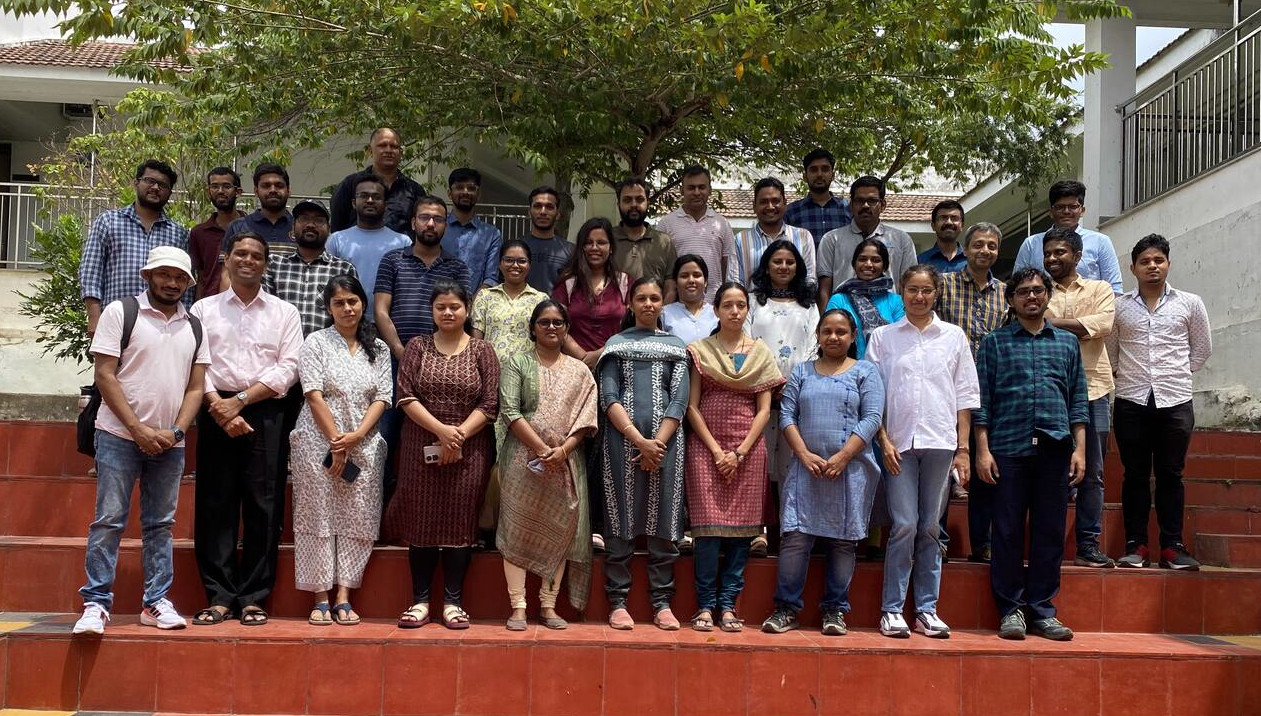
Program schedule for Research Symposium 2024
Coordinates
- When ? - 02 March, 9.00 AM to 4.00 PM
- Where ? - Room 203 and 204, Samgatha Building, Nila Campus, IIT Palakkad
- Coordinators - Kevin, Kutty Malu, Lijo, Chilanka
Talk Schedule
| Time | Title | Speaker |
|---|---|---|
| 9:00 AM - 9:10 AM | Welcome | |
| 9:10 AM - 9:55 AM | Invited talk 1 - Flexible list colorings: Maximizing the number of requests satisfied | Dr. Rogers Mathew |
| 10 minutes of Q +A | ||
| 10:05 AM - 10:50 AM | Invited talk 2 - Some recent work on fractional intersecting families | Brahadeesh Sankarnarayanan |
| 10 minutes of Q +A | ||
| 11:10 AM - 11:20 AM | Tea break | |
| 11:20 AM - 11:40 AM | Arborescences and Shortest Path Trees when Colors Matter | Ardra PS |
| 11:40 AM - 12:00 PM | Parameterized Complexity of Biclique Contraction and Balanced Biclique Contraction | Kutty Malu |
| 12:00 PM - 12:20 AM | Face-hitting Dominating Sets in Planar Graphs | Lijo M Jose |
| 12:40 PM - 1:00 PM | STGraph: A framework for temporal graph neural networks | Kevin Jude Concessao |
| 01:00 PM - 02:00 PM | Lunch | |
| 02.00 PM - 02.20 PM | Scheduling Slice Requests in 5G Networks | Dr. Albert Sunny |
| 02.20 PM - 02.40 PM | Tiny-VBF: Resource-Efficient Vision Transformer based Lightweight Beamformer for Ultrasound Single-Angle Plane Wave Imaging | Abdul Rahoof |
| 02.40 PM - 03.00 PM | Standalone Nested Loop Acceleration on CGRAs for Signal Processing Applications | Chilankamol Sunny |
| 03:00 PM - 04:00 PM | Interactive Session | |
Invited talk 1
Abstract: In classical vertex coloring we wish to color the vertices of a graph $G$ with up to $m$ colors from $[m]$ so that adjacent vertices receive different colors, a so-called ‘proper $m$-coloring’. List coloring is a well-known variation of classical vertex coloring that was introduced independently by Vizing and Erdos, Rubin, and Taylor in the 1970s. For list coloring, we associate a ‘list assignment’ $L$ with a graph $G$ such that each vertex $v$ in $G$ is assigned a list of colors $L(v)$ (we say $L$ is a list assignment for $G$). An ‘$L$-coloring’ of $G$ is a function $f$ with domain $V(G)$ such that $f(v)$ is a member of $L(v)$ for every vertex $v$ in $G$. We say that $G$ is ‘$L$-colorable’ if there exists a proper $L$-coloring of $G$: an $L$-coloring where adjacent vertices receive different colors. A list assignment $L$ for $G$ is called a ‘$k$-assignment’ if $|L(v)|=k$ for each vertex $v$ in $G$. We say $G$ is ‘$k$-choosable’ or ‘$k$-list colorable’ if $G$ is $L$-colorable whenever $L$ is a $k$-assignment for $G$. The ‘list chromatic number’ of $G$ is the smallest $k$ such that $G$ is $k$-choosable.
Flexible list coloring was introduced in [Dvorak, Norin, and Postle. “List coloring with requests”, J.Graph Theory (2019)] in order to address a situation in list coloring where we still seek a proper list coloring, but a preferred color is given for some subset of vertices and we wish to color as many vertices in this subset with its preferred colored as possible, a flexible version of the classical precoloring extension problem. In this talk, we explore the notion of Flexible list colorings. This talk is based on the paper [Kaul, Mathew, Mudrock, and Pelsmajer. “Flexible list colorings: Maximizing the number of requests satisfied”, to appear in J. Graph Theory].
About the speaker: Dr. Rogers Mathew is an Associate Professor in the Department of Computer Science and Engineering, IIT Hyderabad. His research interests are in the areas of combinatorics, graph theory, and graph algorithms.
Invited talk 2
Abstract: For a fraction $\theta = a/b$ in $(0,1)$, a family $\mathcal{F}$ of subsets of $[n]$ is called a “fractional $\theta$-intersecting family” if, for every pair of distinct sets $A, B$ in $\mathcal{F}$, we have $|A \cap B| = \theta|A|$ or $\theta|B|$. The natural extremal question is: How large can a θ-intersecting family over $[n]$ be?
This notion was introduced in Balachandran–Mathew–Mishra (Electron. J. Combin. 26 (2019), #P2.40), wherein they showed that $|\cal{F}| \le O(n \log n)$, and they gave constructions of $\theta$-intersecting families of size at least $\Omega(n)$. The conjecture (which is still open) is whether $|\cal{F}| \le O(n)$ for any $\theta$-intersecting family $\cal{F}$ over $[n]$.
In this talk, I will discuss some recent progress on this conjecture, and some related questions concerning ranks of certain matrix ensembles, tournaments, symmetric designs, and sunflowers.
About the speaker: Brahadeesh Sankarnarayanan is a final-year PhD student at the Department of Mathematics, IIT Bombay. He has just submitted his thesis under the supervision of Prof. Niranjan Balachandran. His research interest is in extremal graph theory and combinatorics.
See here for past instances of the CSE research symposium.
Program schedule for Research Symposium 2023
Coordinates
- When ? - 10 January, 9.30 AM to 5.00 PM
- Where ? - Room 305, Nila Campus, IIT Palakkad
- Coordinator - Shabana (PhD Scholar, 111914007@smail)
Talk Schedule
| Time | Title | Speaker |
|---|---|---|
| 9:40 AM - 9:50 AM | Welcome | |
| 9:50 AM - 10:10 AM | Memory leak detection using Heap Object Flow Graph | Unnikrishnan C |
| 10:10 AM - 10:30 AM | Deep Extreme Mixture Model for Time Series Forecasting | Abilasha S |
| 10:30 AM - 10:50 AM | QoS-aware Scheduling in 5G Wireless Base Stations | Reshma Prasad |
| 10:50 AM - 11:10 AM | CurriculumTutor: An adaptive algorithm for mastering a curriculum | Shabana K M |
| 11:10 AM - 11:30 AM | Tea break | |
| 11:30 AM - 11:50 AM | Balanced Substructures in Bicolored Graphs | Ardra P S |
| 11:50 AM - 12:10 PM | Energy Efficient Loop Acceleration on CGRAs | Chilankamol Sunny |
| 12:10 PM - 12:30 PM | Static Malware Analysis using ELF features for Linux based IoT devices | Akshara Ravi |
| 12:30 PM - 12:50 PM | Dynamic Graph Algorithms on GPUs | Kevin Jude Concessao |
| 12:50 PM - 01:10 PM | Disjoint Total Dominating Sets in Near-Triangulations | Lijo M. Jose |
| 01:15 PM - 02:15 PM | Lunch | |
| 02:15 PM - 02:30 PM | Getting to know the CSE research group | |
| 02:30 PM - 03:30 PM | Informal session with faculty | |
| 03:30 PM - 04:30 PM | Break the Ice! | |